
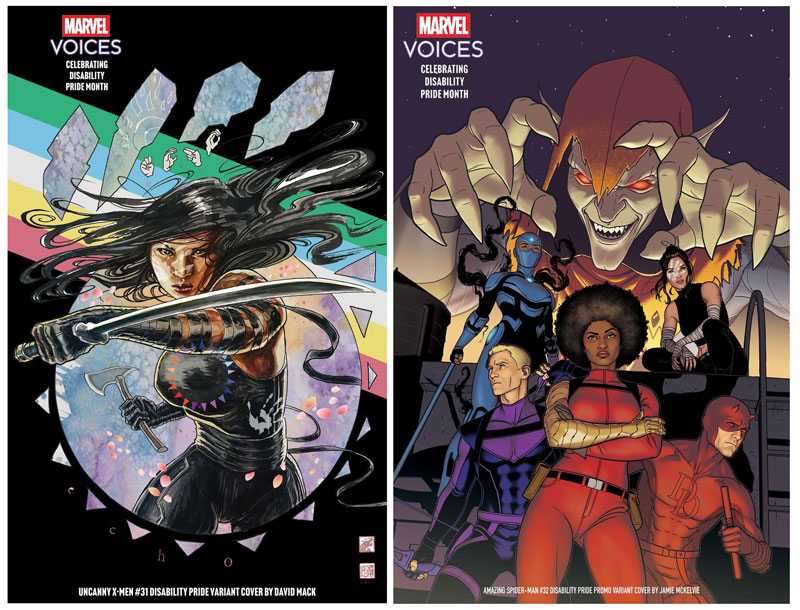
In honor of Disability Pride Month, Marvel Comics is releasing new storylines and special edition covers that celebrate the disability community by highlighting themes of “strength and empowerment,” according to a recent press release. The new comic book series is part of Marvel’s Voices program, “which delivers super-powered storytelling that explores the multitude of unique backgrounds, journeys and identities found in the Marvel Universe.”
Since 1938, when Superman made his debut, superheroes have inspired readers to overcome obstacles, stand up for what’s right, and persevere in the face of adversity. Marvel’s Disability Pride Month campaign inspires readers—disabled and non-disabled—to do the same.
Marvel’s initiative features new backup stories written by Marieke Nijkamp and illustrated by Andrea Di Vito. The campaign also shines a spotlight on some of Marvel’s disabled heroes including Daredevil, blinded by a childhood accident; Misty Knight, who uses a bionic prosthetic arm; Echo, who is deaf; Hawkeye, who is hearing impaired; Silhouette, who uses a wheelchair after being paralyzed below the waist; and Finesse, who’s intellectually gifted and on the autism spectrum. In the new storyline, this diverse group of heroes joins forces to rescue character Colleen Wing from a deadly threat.
As Di Vito explains: “Superheroes are meant to inspire us to be better, but sometimes we forget that the greatest inspirations come from real life. People with disabilities prove to each and every one of us that the true measure of our worth is our spirit and our will, not the limitations of our bodies.”
For many people with disabilities, daily life can involve navigating inaccessible environments, advocating for accommodations, managing chronic health conditions, or responding to prejudice. Those experiences often require persistence, adaptability, and problem-solving skills, qualities that many of our favorite superheroes possess.
Marvel’s initiative also highlights the importance of disability representation. Seeing disabled characters portrayed as leaders, problem-solvers, and multifaceted individuals helps broaden the way disability is depicted in popular culture. For readers with disabilities, that representation can be affirming. For everyone else, it offers an opportunity to see disability through a broader, more authentic lens.