
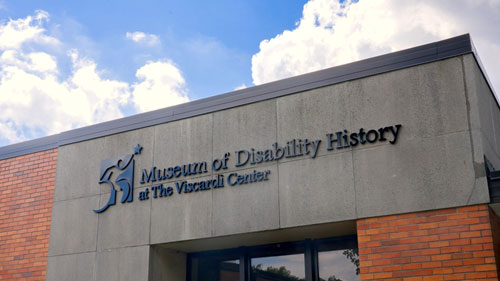
It’s been 10 years since we first introduced our readers to the Museum of Disability History in Buffalo, New York. The museum chronicled the history of the disability movement from its early beginnings — some artifacts date back to the 1750s — through the present day. In 2020, we were disappointed to learn that the pandemic had forced the museum to close.
Now, however, the museum has reopened, and in a larger and more comprehensive form than before.
The new museum building, located in Albertson, Long Island, is now part of The Viscardi Center, a nonprofit disability organization named for Dr. Henry Viscardi — a disability rights advocate who, after facing employment discrimination himself, founded a business that intentionally hired disabled workers. He later advised eight U.S. presidents and played an influential role in advancing disability-rights legislation, including the Americans with Disabilities Act.
Chartered in 1998 by the New York State Board of Regents and founded by Dr. James M. Boles, former president and CEO of People Inc., the museum is believed to be, according to its website, “the first museum in the United States dedicated exclusively to chronicling the history, struggles, and achievements of people with disabilities.”
Over time, the museum has evolved alongside the disability community, raising awareness and encouraging public conversation about disability issues in the United States.
Opening February 17, 2026, the new 4,500-square-foot, fully accessible gallery space in the Kornreich Institute for Disability Studies houses approximately 8,000 photographs, documents, books, and artifacts, mostly from the original museum, along with newly acquired items.
Among the most notable objects are early assistive devices, including a three-wheeled mobility cart and a Braille typewriter, tools people once relied upon to participate in everyday life before modern accessibility technologies. Another display examines a 1990 disability-rights demonstration at the U.S. Capitol, reminding visitors that many of today’s accommodations were the result of organized advocacy and protest. A new exhibition about Dr. Viscardi is located in what was once his office.
In addition to its on-site galleries, the museum offers a traveling exhibition program. These exhibits explore topics such as polio in America, African Americans and disability, adaptive sports, and the relationship between war and disability.
Museum officials hope the renewed interest generated by the reopening may eventually support the creation of a larger national disability history museum on the National Mall in Washington, D.C.