
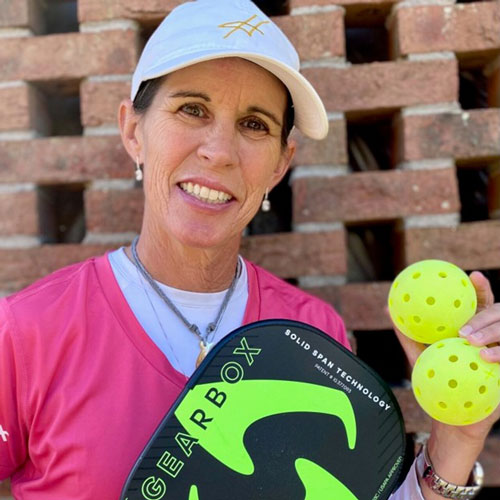
Invented in 1965 by friends Joel Pritchard, Bill Bell, and Barney McCallum, pickleball—a sport that blends aspects of tennis, ping pong, and badminton—picked up steam in 2020, when it became wildly popular, especially with adults who found tennis too strenuous. At roughly the same time, Sandy Halkett, an adaptive golf instructor and athletic director, began developing an adaptive pickleball program for individuals with physical, cognitive, and developmental disabilities. She formed the nonprofit Adaptive Pickleball in 2020. Since then, the sport has been bringing joy, fitness, and community to disabled athletes all over the world.
According to the Empower Pickleball team, “adaptive pickleball is an inclusive version of the sport designed to accommodate individuals with diverse abilities.” For example, in adaptive pickleball, players with intellectual and developmental disabilities receive more guidance from coaches who have the training to address their specific needs.
“Sessions begin with warm-ups and simple drills that cover the basics: serving, returning, dinking, and volleys. … Teachers tailor their methods to meet individual needs, sometimes incorporating adaptive equipment such as wrist supports, Velcro mitts, or stationary targets to support motor skill development and build hand-eye coordination.”
While adaptive pickleball is appropriate for players with a wide range of disabilities, wheelchair pickleball caters especially to those who use wheelchairs. In 2023, wheelchair user Chip Parmelly, a former Paralympic wheelchair tennis player, founded the United States Wheelchair Pickleball Association. He strongly recommends adaptive pickleball for wheelchair users because he believes it is more approachable than wheelchair tennis. As Parmelly told New Mobility magazine:
“It’s less physically demanding than wheelchair tennis, making the game more accessible to people of all fitness levels,” he says. “For one thing, it’s a quarter of the size of a tennis court, so you’re moving less. Plus, it’s a short-punch stroke — you don’t need a big backswing or have to crank the heck out of the ball to get it over the net. You only have to hit it 15–20 feet. Another advantage is that you serve underhand. You don’t need great shoulders or to be a prolific overhead server for pickleball.”
To play wheelchair pickleball, athletes need a sports wheelchair and specially designed paddles. Many clinics have chairs and paddles participants can borrow.
As more people learn about the many advantages of adaptive and wheelchair pickleball, it is becoming easier to find opportunities to play. Adaptive sports programs are adding pickleball to their offerings every day. For more information about adaptive pickleball, visit usapickleball.org/adaptive.
Photo credit: Sandy Halkett, founder of the nonprofit Adaptive Pickleball