
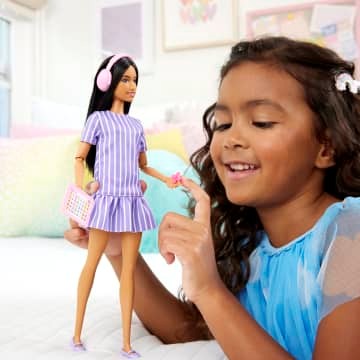
In recent years, corporate America has begun to recognize not only the needs of disabled people, but also their buying power. Mattel, one of the world’s largest toy companies, is no exception.
Earlier this month, the company launched a Barbie doll with autism, the latest addition to a growing line of dolls that Mattel describes as part of its “diversity evolution.” Since 2019, the company has introduced Barbies with a range of disabilities, including dolls who use wheelchairs, have prosthetic limbs, have Down syndrome, or are blind.
Autistic Barbie was developed in collaboration with the Autistic Self Advocacy Network (ASAN), an organization run by and for autistic people that advocates for autistic rights. The collaboration took 18 months.
Autism is often described as an “invisible disability” because it typically isn’t apparent at first glance. It is also a spectrum, which is why advocates often say, “If you’ve met one autistic person, you’ve met one autistic person.” In other words, every autistic person is an individual.
So how does a doll portray neurodiversity? According to Mother & Baby, autistic Barbie was designed to “spotlight common autistic experiences related to sensory processing and communication.”
The doll’s elbows and wrists can be positioned to simulate stimming and hand-flapping—behaviors some autistic people use to regulate sensory input. Her eyes gaze slightly to the side rather than straight ahead, reflecting the discomfort many autistic individuals experience with direct eye contact. The doll also comes with accessories that reflect common accommodations, including noise-canceling headphones to manage auditory overstimulation, fidget toys to support regulation and focus, and an AAC (augmentative and alternative communication) device used by some nonverbal autistic people. Autistic Barbie even wears a sensory-friendly outfit — a loose-fitting dress and flat shoes designed with comfort in mind.
Zoe Gross, ASAN’s director of advocacy, told Good Housekeeping that the doll sends an important message: autistic people are everywhere, and disability is simply a normal part of human diversity, not something to fear or avoid.
Gross has said she hopes autistic children who play with the doll will recognize that needing accommodations is nothing to be ashamed of. At the same time, the doll challenges stereotypes by showing that autistic people can still be stylish, joyful, and expressive, even while using tools like headphones or communication devices.
Autistic Barbie isn’t intended only for neurodiverse children. Its creators also hope that neurotypical children will play with her.
Said Gross: “Imagine a situation where a child learns about autism and accommodations like AAC by playing with this doll. When that child meets an autistic classmate who uses a device to communicate, this won’t seem strange, new, or scary to the child. They will just think that their classmate is like Barbie.”